

By Patrick Harders, LC, Founder & Principal Lighting Designer, Dayloom

Short answer: An installer walks your property with flags marking the layout. A designer hands you a plan. Choose a landscape lighting designer the way you would choose an architect: look for full design documentation, a recognized lighting credential, peer-judged awards, and the proper Virginia contractor license. The documentation includes lighting plans, a fixture schedule, target light levels, a wire diagram with load calculations, and conceptual renderings. Be cautious of anyone whose “design” is a row of flags and a price per fixture.
I have designed landscape lighting since 1998 and have served Northern Virginia since 2001. Over that time, I have seen beautiful systems and systems that had to be torn out and redone. The difference almost always comes down to who was hired and how they worked. This guide is written for homeowners in Great Falls, McLean, Middleburg, and across Northern Virginia who want to get it right the first time.
What is the difference between a lighting designer and a lighting installer?
This is the most important distinction in this guide.
A typical installer walks the property, often in daylight, carrying marking flags, and pushes a flag into the ground wherever a fixture might go. The proposal is a fixture count and a price. The “design” lives in the installer’s head and in those flags, and once the flags are pulled, there is no record of what was intended or why.
A designer treats your property the way an architect treats a building. The work produces a complete set of documents, and you keep them:
- Lighting plans and drawings showing every fixture location and what each one is meant to reveal.
- Fixture selection and a fixture schedule listing every luminaire by model, beam angle, color temperature, and output setting.
- Target light levels for each zone, so the entry, paths, trees, and façade sit in a deliberate hierarchy instead of competing.
- A wiring diagram with line-load calculations showing how each fixture connects to each transformer and that voltage and load are properly balanced across every run.
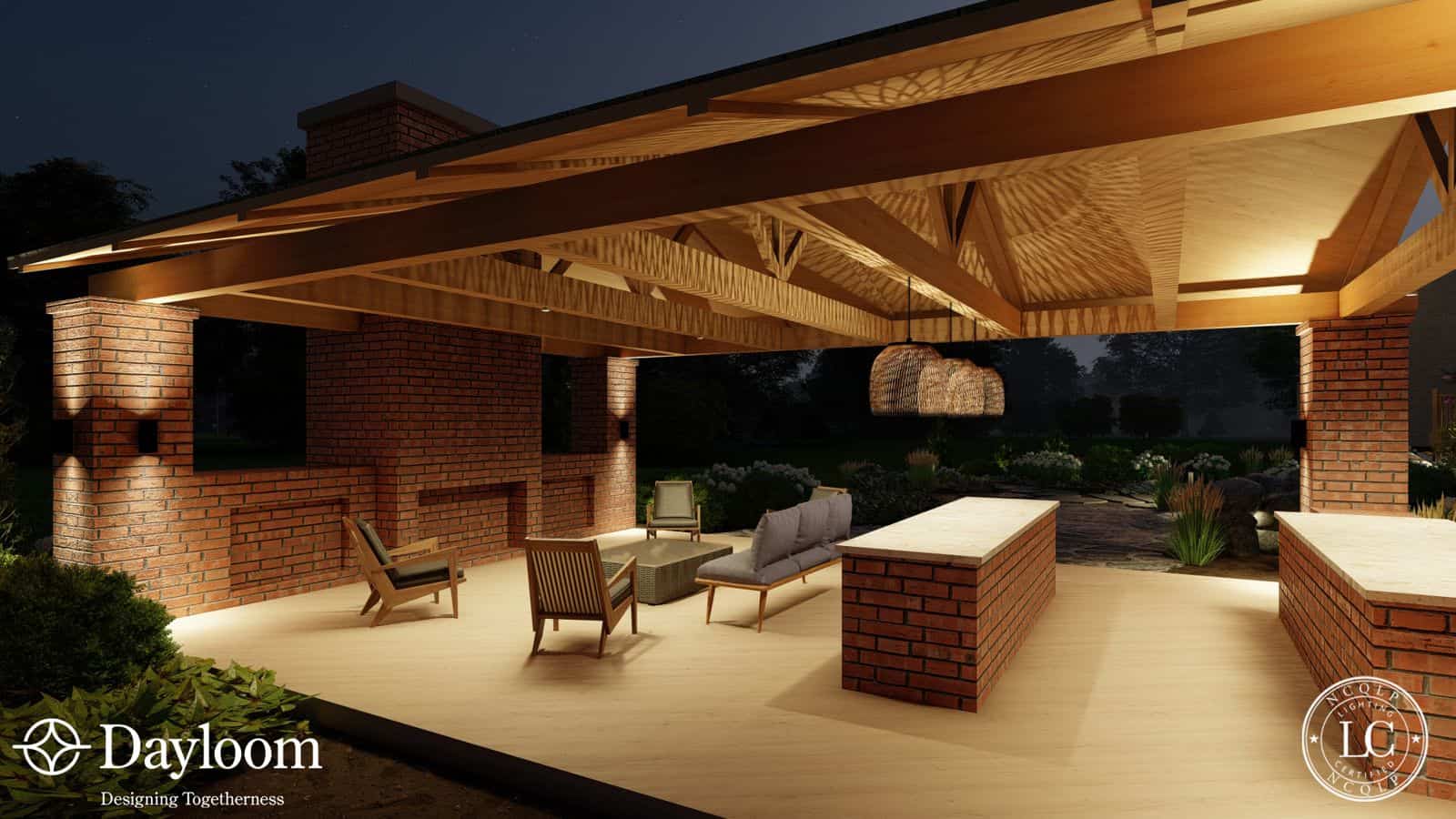
- Conceptual renderings so you can see the intended effect before anything is installed.
- Full system documentation at completion, so any future service technician or owner of your home knows exactly what was installed and how it works.

| Typical installer | Lighting designer | |
|---|---|---|
| Site visit | Daylight walk with marking flags | Study of architecture, landscape, views, and night conditions |
| Plan | Flags in the ground | Scaled lighting plans and drawings |
| Fixtures | Count and price | Fixture selection and full fixture schedule |
| Light levels | Not specified | Target light levels by zone |
| Wiring | Decided in the field | Wire diagram with line load calculations |
| Preview | Verbal description | Conceptual renderings |
| What you keep | An invoice | Complete documentation of your system |
Quotable takeaway: Flags mark where a light might go. A plan explains why it goes there, how bright it should be, and how it is powered.


Some firms do both well. When you interview a firm, ask to see a sample set of the documents it delivers. If none exist, you are hiring an installer.
Which credentials should a landscape lighting designer have?
The industry has no single required license for landscape lighting design, so credentials tell you a lot about a designer’s commitment.
- Lighting Certified (LC). Granted by the National Council on Qualifications for the Lighting Professions (NCQLP), the LC is a broad professional credential covering lighting principles and practice. I hold the LC.
- AOLP certifications. The Association of Outdoor Lighting Professionals offers credentials for outdoor lighting work, such as the Certified Low Voltage Lighting Technician (CLVLT). These show training in low-voltage outdoor systems.
- A Virginia contractor license with the right specialty. In Virginia, the Department of Professional and Occupational Regulation (DPOR) licenses contractors through the Board for Contractors. Low-voltage systems (50 volts or less) fall under the Electronic/Communication Service Contracting (ESC) specialty. An Electrical (ELE) contractor classification also covers that work. You can look up any firm’s license on DPOR’s website. A landscaping license alone (the Landscape Service Contracting, or LSC, specialty) covers grading and landscaping work, not lighting systems.
Credentials don’t guarantee great design, but a designer with none who can’t explain why is worth a second look.
How can you judge a designer’s portfolio and awards?
Photos are curated, so look for independent recognition. Industry awards like those from the AOLP and the international LIT Lighting Design Awards are judged by peers, not chosen by the firm.
Dayloom’s work has earned 3 international LIT awards plus 8 North American AOLP awards, and the Willing Warriors Retreat was named a LIT Lighting Project of the Decade.
When reviewing any portfolio, ask:
- Are these the designer’s own projects, not manufacturer stock photos?
- Do the photos show properties of a similar scale and architecture to yours?
- Can you see the lighting in person at night, at a past project or in a demonstration?
- Is there glare in the photos? Bright, visible fixtures and hot spots are a warning sign even in professional photography.
What questions should you ask before hiring a landscape lighting designer?
Use these twelve questions with every firm you interview:
- Will I receive full design documentation (lighting plans, fixture schedule, target light levels, wire diagram with load calculations, and renderings), and may I see a sample set?
- Who will design my system, and what are their credentials?
- Will that person be on site at night for final aiming and adjustment?
- Do you provide a nighttime demonstration, a rendering, or both?
- Which fixtures do you specify, and why? Ask about materials, color rendering (CRI), color temperature, optics, and how output is adjusted.
- How do you prevent glare and light trespass onto neighboring properties and the night sky?
- How is the system controlled? Ask about timers, astronomical clocks, dimming, and scenes.
- How do you design for a landscape that will grow? Trees mature; the plan should anticipate the need to re-aim and adjust.
- What warranties apply to fixtures, transformers, and artistry?
- What does ongoing maintenance include, and what does it cost?
- Can I speak with past clients or see completed work?
- Does Virginia DPOR license your firm with the ESC specialty or an ELE classification?
A strong designer will welcome every one of these questions.
Why does fixture knowledge matter when choosing a designer?
The fixture produces the light, so a designer’s understanding of fixtures limits design quality. Color rendering decides whether limestone looks warm or chalky. (For how warm or cool the light itself should be, see our guide to the best color temperature for residential landscape lighting.) Optics decide whether a beam lands crisply on a tree or spills into the sky. Housing materials decide whether the system still performs years from now.
This is where Dayloom is different. In addition to leading Dayloom, I am CEO and lead fixture designer of Sterling Lighting, a landscape lighting fixture company. Sterling’s IN27 path light received a 2025 LIT award for product design. Designing luminaires and designing landscapes inform each other: field experience shapes the fixtures, and fixture engineering sharpens the design.
You don’t need a designer who makes fixtures. You do need one who can explain exactly why they chose each fixture for each place.
What are the red flags when hiring a landscape lighting company?
- A flag walk instead of a plan. If the only design deliverable is marking flags and a fixture count, there is no design to hold anyone to and nothing documented for the future.
- No wire diagram or load calculations. Wiring decided in the field can lead to uneven brightness and overloaded runs.
- No license you can verify. Check the firm on DPOR’s license lookup.
- Pricing per fixture before anyone has looked at the property. It focuses the conversation on counting lights, not on the effect.
- A “standard package.” Every property is different. A package means the same plan is being repeated.
- No nighttime component. Lighting is judged at night. A designer who only walks the property in daylight is guessing.
- Vague fixture specifications, or no fixture schedule. “Brass LED lights” is not a specification. Ask for models, color temperature, output, and beam angles.
- Visible glare in the portfolio. If you can see the bright source in photos, you will see it from your terrace.
- Lighting everything. Good design uses shadow deliberately. Even, flat brightness across a property signals inexperience.
- No maintenance plan. Systems need re-aiming as landscapes grow and occasional service. A firm that disappears after installation leaves you with a fading result.
- Pressure to sign immediately. Thoughtful design takes conversation.

What should the design process look like?
At Dayloom, a project generally follows this path:
- Consultation. We discuss how you use your property after dark, what you want to see from inside, and the character you want.
- Site study. We study the architecture, landscape, approach, and views, including evening observation.
- Design documents. We produce lighting plans and drawings, fixture selection and a fixture schedule, target light levels, a wire diagram with line load calculations, and conceptual renderings.
- Presentation and refinement. We walk you through the plan and renderings and refine them with you before anything is installed.
- Installation to the plan. We install fixtures, wiring, transformers, and controls as documented, with care for the landscape.
- Night aiming and balancing. We adjust every fixture on site after dark until the scene matches the design.
- Documentation hand-off. You receive complete as-built documentation of your system.
- Ongoing care. Maintenance and re-aiming keep the design right as your landscape matures.

Frequently Asked Questions
What should a landscape lighting design include? At minimum: lighting plans and drawings, fixture selection with a fixture schedule, target light levels, a wire diagram with line load calculations, and conceptual renderings. Complete system documentation should be handed over at the end.
What license does a landscape lighting contractor need in Virginia? Virginia contractors are licensed through DPOR’s Board for Contractors. Low-voltage systems fall under the Electronic/Communication Service Contracting (ESC) specialty, which the Electrical (ELE) classification also covers. Verify any firm on DPOR’s license lookup.
Is a landscape lighting designer worth the cost compared to a general contractor? For fine properties, usually yes. Design determines whether the system looks refined or merely bright, and redoing poorly designed lighting costs more than designing it right.
What does the LC credential mean? Lighting Certified (LC) is a professional credential from the NCQLP. It recognizes broad knowledge of lighting principles and practice across the lighting professions.
Should I get multiple proposals? Yes. Compare design reasoning, fixture specifications, and service plans, not just totals.
How far ahead should I plan? The earlier, the better, especially for new construction, when you can plan conduit and power before hardscape is installed.
What areas does Dayloom serve? Northern Virginia, including Great Falls, McLean, Middleburg, Leesburg, and Aldie, as well as Washington, DC, and Maryland.
Interviewing lighting designers for your home?
We would be glad to be part of the conversation. If you own a distinguished home in Great Falls, McLean, Middleburg, or elsewhere in Northern Virginia, call Dayloom at 703-636-5225 and ask us all twelve questions, including to see our design documents.
About the Author
Patrick Harders, LC, founded Dayloom, a lighting design firm in Aldie, Virginia. He is also CEO and lead fixture designer of Sterling Lighting, a landscape lighting fixture company. He has designed landscape lighting since 1998, has served Northern Virginia since 2001, and holds the Lighting Certified (LC) credential from the NCQLP. Dayloom’s work has earned 3 international LIT awards plus 8 North American AOLP awards, and the Willing Warriors Retreat was named a LIT Lighting Project of the Decade. Sterling’s IN27 path light received a 2025 LIT award for product design.
The Washington Post, the Washington Business Journal, Designing Lighting magazine, and the book Masters of Landscape Lighting have featured Patrick’s work and perspective.


