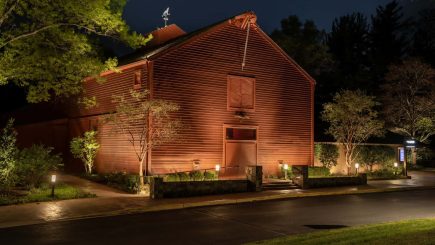
In landscape lighting, the small things make a big difference. The position of a luminaire, the beam angle, the Kelvin temperature—they all matter. But one factor that often goes overlooked is CRI: the Color Rendering Index.
CRI is one of the most misunderstood yet essential components of light quality. If you’ve ever wondered why some lighting designs pop while others feel flat, this is where to start.
What Is CRI?
CRI stands for Color Rendering Index. It’s a scale from 0 to 100 that measures how accurately a light source reveals the true colors of objects, compared to natural sunlight. A CRI of 100 mimics what you’d see in direct daylight, which is our baseline for true color perception.
So, when we say something has a high CRI, we’re talking about its ability to help your eyes see more color—more accurately and with more vibrancy.
Why Does CRI Matter in Landscape Lighting?
Think back to the orange-yellow glow of sodium vapor streetlights we grew up with. Under that light, colors were washed out and muddy. That’s low CRI in action, often in the 40–60 range.
Now compare that to what we use at Sterling Lighting. Our luminaires rate between 97 and 99 CRI. That’s not just a technical detail—it’s a real-world advantage.
When you light a tree, it’s not just brown bark and green leaves. It’s five or six shades of brown running up the trunk, and seven or eight variations of green in the canopy. High CRI lighting reveals that subtle complexity. It brings the scene to life.
More Color, More Impact
After installing over 10,000 lighting systems, you start to notice which designs feel alive—and which fall flat. One of the biggest factors? CRI.
Most landscape lighting products on the market have a CRI of around 82. That’s considered passable, but it leaves a lot on the table in terms of visual clarity. At Dayloom, we don’t settle for “good enough.” Our luminaires start at 97 CRI, delivering an incredibly high-fidelity light that shows your work in its best light—literally.
Why does that matter?
Here’s what high CRI lighting gives you:
- Enhanced Detail – You’ll see textures, shapes, and shadows with more clarity and depth.
- Truer Colors – Plants, stonework, architecture—everything reads accurately and vividly.
- Design Confidence – You can trust that your vision will come through exactly as intended.
- Client Satisfaction – Even if clients don’t know what CRI means, they’ll instantly notice the difference.
You might not think about CRI every day, but you’ve experienced its importance in places where color really matters: beauty salons, high-end grocery stores (especially the produce section), and cosmetic counters. These industries rely on accurate color rendering to enhance appearance and build trust. Why wouldn’t we hold our landscape lighting to the same standard?
Designing with CRI in Mind
Whether you’re working on a residential garden or a commercial courtyard, high CRI gives you more creative control. It helps you tell the story of a space, not just light it.
Want to showcase a red maple’s foliage? You’ll need high CRI to capture its richness. Want to show off the nuances in a stone wall? A high-CRI luminaire reveals what lower-quality lights would miss.
CRI vs. Kelvin: What’s the Difference?
CRI and Kelvin serve different purposes. Kelvin measures the color temperature of the light—how warm or cool it feels. CRI measures how accurately that light renders color.
A 2700K light can feel warm and inviting, but if the CRI is low, it may still distort the actual colors of your landscape. Both metrics matter, but when you want precision and beauty, CRI is what brings your design to life.
Final Thoughts
CRI isn’t just a number on a spec sheet. It’s a direct indicator of how good your lighting will actually look. And in a field where visuals are everything, it’s one of the smartest specs to pay attention to.
At Sterling Lighting, we design our luminaires with CRI in mind—because your projects deserve that level of quality.
If you want your lighting systems to capture all the detail, beauty, and richness of the landscape, start with the right light. CRI is where that begins.